


If you are looking for the latest web hosting statistics and market share information, you have come to the right place. This article provides the top web hosting statistics and insights into the largest web hosting companies, helping you understand the industry’s growth, trends, and leading providers as a website owner. Staying up-to-date with the latest developments in the web hosting industry is essential.
Understanding the role of a web hosting company and the major players in the hosting market is crucial for website owners to choose the best provider for a successful WordPress website.
In this article, we’ve compiled a wealth of web hosting statistics and market share information.
General Web Hosting Industry Statistics
1. There are over 330,000 web-hosting providers worldwide.
With a staggering count of over 330,000 web-hosting providers spread across the globe, the web-hosting industry is highly competitive and diverse. These providers offer a range of services and packages to meet the ever-growing demand for an online presence.

2. In 2025, there were more than 1.13 billion websites around the world.
In 2023, the digital landscape boasted an impressive figure of over 1.13 billion websites worldwide. Though the number seems high, only 18% of these websites are actively maintained and visited today. Over 350 million of these websites are registered in the United States.
3. WordPress accounts for 63.1% of all CMS systems hosted.
The Content Management System (CMS) landscape is dominated by WordPress, which commands a substantial 63.1% share of all CMS systems hosted online. This popularity can be attributed to WordPress’s user-friendliness and versatility.
4. About 43.3% of all websites are built on WordPress.
WordPress’s dominance extends to individual websites as well, with a significant 43.3% of all websites being built on its platform. This highlights the widespread adoption of WordPress as the preferred choice for numerous web projects.
5. IT services will allocate 32% of their tech spending toward the cloud.
WordPress’s dominance extends to individual websites as well, with a significant 43.3% of all websites being built on its platform. This showcases the wide adoption of WordPress as a preferred choice for various web projects.
6. In 2025, there were over 1.21 billion hostnames registered online.
The digital landscape is a domain-rich environment, as evidenced by the over 1.21 billion hostnames registered online in the year 2025. The number has grown significantly since the first four hosts were registered in 1969. These hostnames represent a wide range of websites, services, and online resources.
7. The US hosts account for about 27% of all web domains registered which is over 50 million domains.
Among the multitude of web domains registered globally, the United States hosts a significant share, accounting for around 27%. This translates to over 50 million registered domains, underlining the country’s influential role in the online world.
8. The United States of America holds the largest share of hosting providers at 51.42%.
As a major player in the web hosting industry, the United States of America stands out by housing the largest number of hosting providers. This concentration of providers reflects the country’s robust technological infrastructure and market demand.
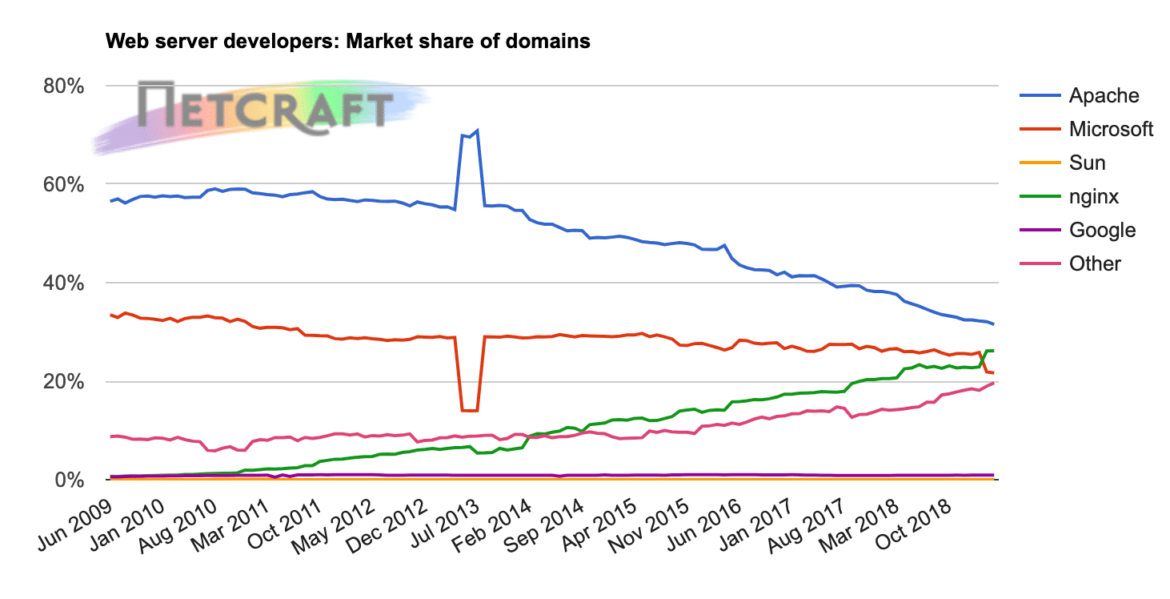
9. Nginx’s hosting servers gained the most websites, increasing to nearly 441 million, in 2021.
Nginx, a popular web server software, has experienced substantial growth, powering nearly 441 million websites as of 2021. It is the most used web server among the top 1000 websites. This increase underscores its efficiency and effectiveness in handling web traffic and content delivery.
10. China is the country with the second-highest number of domains registered (16 million).
The high number of registered domains in China reflects the country’s rapidly growing internet usage and digital economy. It also highlights the importance of online presence for businesses and individuals in today’s interconnected world. This statistic underscores the need for effective digital marketing strategies and strong online security measures to protect sensitive information.
Web Hosting Market Share & Size
- North America holds over 42% of the global web hosting market share, as of 2023.
North America has established a significant dominance in the global hosting market, capturing over 42% of the market share as of 2023. This sizable portion underscores the continent’s advanced technological infrastructure and its role as a hub for online services. The global hosting market continues to experience strong market growth, driven by increasing demand for digital services and cloud adoption. According to recent industry reports, the compound annual growth rate (CAGR) of the web hosting industry is projected to remain robust over the next several years. Europe comes second to them.
- The leading cloud hosting technology worldwide is Amazon Hosting, with a 32% market share.
Amazon Hosting stands as the leading technology in the web hosting industry on a global scale, commanding a noteworthy 32% market share. Amazon, along with Microsoft and Google, dominates the cloud hosting market, which has become the preferred choice for businesses due to its scalability and flexibility. The widespread adoption of Amazon Hosting showcases its reliability and scalability for businesses and individuals seeking reliable web hosting solutions.
When considering hosting types, dedicated hosting services are a premium option for businesses that require high uptime, enhanced security, and dedicated resources as their operations and traffic grow.
13. Joomla is the 5th among the popular CMSs, with 2.5% of the market share.
Amazon Hosting stands as the leading technology in the web hosting industry on a global scale, commanding a noteworthy 4.87% market share. The widespread adoption of Amazon Hosting showcases its reliability and scalability for businesses and individuals seeking reliable web hosting solutions.
13. CMS market share (W3Tech)
Rank
CMS
CMS Market Share
Website Share
1
WordPress
63.1%
43.1%
2
Shopify
5.8%
4.1%
3
Wix
3.6%
2.3%
4
Squarespace
3.0%
2%
5
Joomla
2.6%
1.6%
6
Drupal
1.7%
1.2%
7
Adobe Systems
1.6%
1.1%
8
Google Systems
1.2%
0.9%
9
Bitrix
0.9%
0.8%
10
OpenCart
0.8%
0.6%
14. WordPress has grown in popularity in e-commerce and other industries. It’s not just used for blogging anymore. 43.3% of the websites on the internet today are powered by WordPress.
WordPress has evolved beyond its origins as a blogging platform, gaining prominence in e-commerce and other sectors. Today, WordPress powers countless online stores and supports a wide variety of web apps, making it a versatile choice for businesses and developers alike. A remarkable 43.3% of all websites on the internet are powered by WordPress, showcasing its adaptability and wide-ranging capabilities.
The surge in online shopping, especially during the pandemic, has significantly contributed to WordPress’s growth in the e-commerce space.
15. The WordPress ecommerce plugin WooCommerce has a 19.7% market share of all WordPress sites.
Within the WordPress ecosystem, the WooCommerce e-commerce plugin has secured a substantial 19.7% market share of all WordPress sites. Many hosting plans for WooCommerce also include a free domain as an added benefit, providing additional value and cost savings for new store owners. This highlights WooCommerce’s effectiveness in enabling online stores and transactions within the WordPress framework.
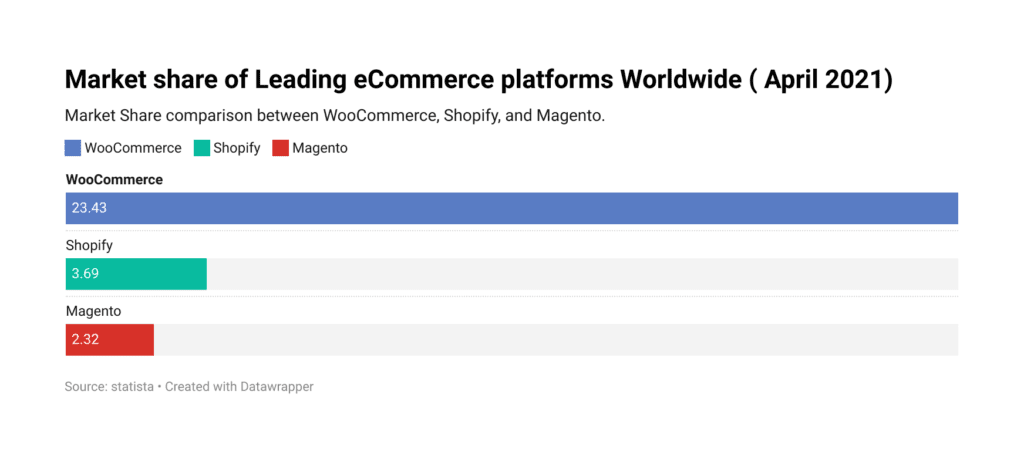
- WooCommerce has the largest market share of a whopping 23.43% among the entire eCommerce industry.
Statista reports show WooCommerce to continue being a leader in the ecommerce industry in building online stores. The closest competitors to WooCommerce are Shopify and Magento coming in at 3.69% and 2.32%. This does seem like there will be a big shift any time soon.
17. The global web hosting market value is expected to grow to to reach $395.84 billion by 2030. In 2023 the value stands at $108.54 billion.
According to Fortune Business Insights, The global web hosting services market is on a trajectory of growth, with a projected value of $108.54 billion in 2023. This anticipated expansion from a $94.64 billion valuation in 2022 reflects the increasing reliance on online services and the digitalization of various industries. The demand for managed services is also rising, as businesses seek professional support to handle IT infrastructure, security, and maintenance, allowing them to focus on core activities. Web hosting now plays a critical role in business operations, enabling companies to adapt workflows and leverage digital transformation. Choosing the right hosting solution is essential for maintaining website performance, accessibility, and supporting business growth. It is projected to grow from $395.84 billion by 2030, exhibiting a CAGR of 20.3% during the forecast period.
- Over 40 million websites use GoDaddy’s data centers.
Did you know that GoDaddy’s data centers are used by over 40 million websites? This is a testament to the reliability and quality of GoDaddy’s services. With such a large customer base, it’s clear that GoDaddy is a trusted choice for website hosting and management. Whether you’re a small business owner or a large corporation, GoDaddy’s data centers can provide the support and infrastructure you need to keep your website running smoothly. So if you’re looking for a reliable web hosting provider, it’s worth considering GoDaddy’s services.
More Web Hosting and Market Share Statistics
- As of Q3 2020, there were 370.7 million registered domains across all top-level domains, and over 330,000 web hosting providers (Verisign, 2020; Hosting Tribunal, 2020). When registering a domain, users typically go through a domain registrar, which is a company authorized to reserve and manage domain names. The most popular domain registrar is GoDaddy, known for its large customer base and brand recognition.
- According to Global Industry Analysts, the demand for web hosting services has increased due to the COVID-19 pandemic, causing the global market to grow at a readjusted CAGR of 18% from 2020 to 2027. The market is predicted to reach $321.5 billion by 2025, up from $102 billion in 2020.
- In 2020, small and medium enterprises had a high adoption rate of shared web hosting, resulting in a 37.64% market share for this segment (Grand View Research). Businesses also utilize dedicated servers and reseller hosting as part of their hosting strategies to meet different needs.
- The top 10 hosting companies control 24% of the web hosting market (Website Hosting Insider, 2017). Leading providers such as Amazon Web Services, Microsoft Azure, and Liquid Web are recognized for their reliability, performance, and comprehensive service offerings.
- According to HostAdvice’s 2021 report, the three most popular web hosts are GoDaddy (11.64%), Google Cloud Platform (4.99%), and 1&1 (4.34%).
- The United States has the highest number of hosted domains with 107,346,685, followed by China with 28,913,029 and Canada with 15,517,622 (Domain Name Stat, 2021).
- The web hosting industry is mostly dominated by local companies. For instance, in the Czech Republic, all of the top 10 hosting providers are local, while in Italy, 8 out of the top 10 are Italian companies. Similarly, in France, 7 out of the top 10 hosting websites are French, and in Germany, 7 out of the top 10 hosting companies are German (HostAdvice, 2021).
- According to Cisco’s 2020 report, by 2023, over 70% of the world’s population will have access to mobile connectivity. In 2020, mobile devices accounted for 52.1% of the global market share, compared to 44.2% for desktop devices (TechJury, 2021).
- According to HostAdvice’s report as of March 2021, the United States dominates the global web hosting market with a share of 51.14%. Germany stands in second place with a distant share of 11.65%, followed by the UK with 4.19%, Japan with 3.33%, France with 3.31%, Netherlands with 3.07%, Canada with 2.59%, China with 2.47%, Russia with 2.13%, and Italy with 1.41%.
- The global shared hosting market size has grown steadily over the last five years; 2015 ($14.05 billion), 2016 ($15.53 billion), 2017 ($17.07 billion), 2018 ($18.67 billion), and 2019 ($20.29 billion). In 2020, it was projected to reach $22 billion (Microsoft, 2017).
- At the same time, the global cloud computing market has recorded a similar trend in the last five years; 2015 ($72.1 billion), 2016 ($85.96 billion), 2017 ($101.21 billion) and 2018 ($117.96 billion), and 2019 ($136.22 billion). In 2020, it was forecast to reach $156.4 billion (Hosting Tribunal, 2020). Many businesses are adopting multi-cloud strategies, leveraging multiple cloud providers such as Amazon Web Services, Microsoft Azure, and Google Cloud to optimize performance, enhance flexibility, and avoid vendor lock-in. These major cloud providers dominate the market and support a wide range of hosting and cloud services.
- In the US alone, GoDaddy controls 22.51% of the web hosting market. On the other hand, 1&1 is the leading hosting service provider in Germany, dominating 26.77% of the market. Other leading web hosting service providers by country include Aliyun (33.94%) in China, Host Europe (11.73%) in the UK, and XServer (14.49%) in Japan (HostAdvice, 2021).
- Endurance International Group (EIG) empowers more than 60 web hosting brands, including BlueHost, HostGator, SiteBuilder, Domain.com, BuyDomains, iPage, FatCow, and HostMonster (ReviewHell, 2020).
- GoDaddy Group controls 6.6% of the global brand’s market share, followed closely by Amazon (5.9%), Endurance Group (4.9%), OVH (4.2%), and Google (Hosting Tribunal, 2020).
- In total, there are 507,743,033 registered domains today, and the number is increasing at a steady rate (Domain Name Stat, 2021).
- Also, there are 245,800,660 domains registered in unknown countries, whereas 4,561,634 domains are hidden (Domain Name Stat, 2021).
- As of 2021, the top domain name registrars include GoDaddy.com, LLC (15.13%), NameCheap Inc (2.54%), Tucows Domain Inc (2.36%), Network Solutions, LLC (1.47%), Alibaba Cloud Computing (Beijing) Co., Ltd. (1.41%), PDR Ltd. (1. 23%), eNom, LLC (1.22%), 1&1 IONOS SE (1.16%), Google LLC (1.12%), and GMO Internet, Inc. d/b/a Onamae.com (1.07%) (Domain Name Stat, 2021).
- On average, 900,000 domains are registered every week (HostSorter, 2020).
- In addition, Wix gained 98.67% new clients from the Google Cloud Platform. Other top gainers include OVH (65.38% new clients from In2net), Google Cloud Platform (57.98% new clients from GoDaddy), HostGator (53.85% new clients from BlueHost), and BlueHost (50% new clients from HostGator) (HostAdvice, 2021).
- Hosting providers invest heavily in data center infrastructure to ensure high reliability, redundancy, and security for their services. Leading providers also offer advanced security features, such as DDoS protection and built-in CDNs, to meet the needs of security-conscious businesses.
Website Hosting Economic Impact Statistics
19. The dedicated web hosting market share reached $14.26 billion, in 2022. (Forecasted to $42.93 billion by 2029)
The Dedicated Server Hosting Market was valued at US$ 14.26 Bn. in 2022. Global Dedicated Server Hosting Market size is expected to grow at a CAGR of 18.9 % through the forecast period. This market value is expected to reach 47.93 billion by 2029. In the year 2022, the dedicated web hosting market demonstrated its significance by reaching this market share value. Dedicated hosting, which offers enhanced control and resources for individual websites, contributes to the overall economic landscape of the web hosting industry.
20. The shared web hosting market share reached $22 billion, in 2020.
Shared web hosting, a popular web hosting choice for cost-effective hosting solutions, made a substantial impact in 2020, reaching a market share of $22 billion. Shared hosting allows multiple websites to share resources on a single server, catering to a wide range of websites with varying needs.
21. Speed is crucial for clients and providers alike. The World economy loses around $6.8 billion every year due to slow websites.
In the realm of website performance, speed emerges as a critical factor with far-reaching economic implications. Slow-loading websites not only frustrate users but also impact businesses and the economy at large. The World economy suffers an estimated loss of around $6.8 billion annually due to the negative consequences of slow websites. This emphasizes the importance of optimizing website speed for user satisfaction and economic prosperity.
22. Speed is crucial for clients and providers alike. The World economy loses around $6.8 billion every year due to slow websites.
In the realm of website performance, speed emerges as a critical factor with far-reaching economic implications. Slow-loading websites not only frustrate users but also impact businesses and the economy at large. The World economy suffers an estimated loss of around $6.8 billion annually due to the negative consequences of slow websites. This emphasizes the importance of optimizing website speed for user satisfaction and economic prosperity.
Regional Web Hosting Market Statistics
The global web hosting market is shaped by dynamic regional trends, with each area contributing uniquely to the industry’s overall growth and innovation. For web hosting providers and businesses seeking to expand their digital footprint, understanding these regional differences is crucial for making informed decisions.
North America remains the powerhouse of the global web hosting market, accounting for the largest share of hosting providers and web hosting revenue. The region’s advanced digital infrastructure, high internet penetration, and strong demand for cloud hosting and managed hosting services make it a prime location for both established and emerging hosting companies. The United States, in particular, leads with the highest number of registered domains and data centers, making it a central hub for global web hosting solutions.
Europe follows closely, with a robust web hosting market characterized by a mix of international giants and strong local hosting providers. Countries like Germany, the UK, and France have thriving hosting industries, often dominated by homegrown companies that cater to regional preferences and regulatory requirements. The European market is also notable for its emphasis on enhanced security, data privacy, and compliance with strict data protection laws.
Asia Pacific is experiencing rapid growth in the web hosting industry, driven by increasing internet adoption, a surge in online businesses, and expanding e-commerce activity. China and India are leading the charge, with millions of new websites and domains registered each year. The region’s web hosting market is marked by fierce competition among local and global hosting providers, as well as a growing demand for scalable cloud hosting and virtual private server hosting solutions.
Emerging markets in Latin America, the Middle East, and Africa are also contributing to the expansion of the global web hosting market. As internet connectivity improves and more small businesses and entrepreneurs come online, these regions are seeing a rise in demand for affordable hosting plans, domain registration, and website management services.
For web hosting providers and businesses looking to grow internationally, keeping an eye on regional web hosting trends and market shares is essential. Tailoring hosting solutions to meet local needs, understanding regulatory environments, and leveraging regional strengths can help companies capture new opportunities in the ever-evolving global web hosting landscape.
Web Hosting Trends & Predictions
Out of all sub-sectors, managed VPS is expected to expand by the highest CAGR of 16.5% from 2019 to 2026.
According to a survey in June 2021, a loss of 5.15 million sites, a gain of 513,000 domains, and 47,100 web-facing computers were reported
The Virtual Private Server (VPS) market is expected to have a value of $2 billion by 2025.
By 2025, only 1% of cloud security incidents will be due to the provider’s fault, and the rest will be due to customers’ mistakes.
The value of the ecommerce software market in the US will reach $6.3 billion by 2023, with US consumers spending $861.12 billion online.
Ten out of 10 hosting leading firms in the Czech Republic’s market are local.
A zettabyte is equal to one trillion gigabytes and by 2025, the global data sphere will reach 175 zettabytes.