


The web hosting industry has grown significantly over the years, with projections showing continued growth into 2028.
It is estimated that the global revenue for this market will reach $124.80 billion in 2023 and grow to a market volume of $345 billion by 2028, representing an annual growth rate (CAGR) of 22.55%.
The hosting services market size is projected to reach these valuations, highlighting its significance as a key measure of market expansion and industry scale. The global web hosting industry is expected to see robust growth, driven by factors such as increased cloud adoption and advancements in AI technologies.
The average spend per employee in the web hosting sector is expected to reach $35.81 in 2023, positioning web hosting service as an essential solution for businesses worldwide due to its critical role in supporting online operations.
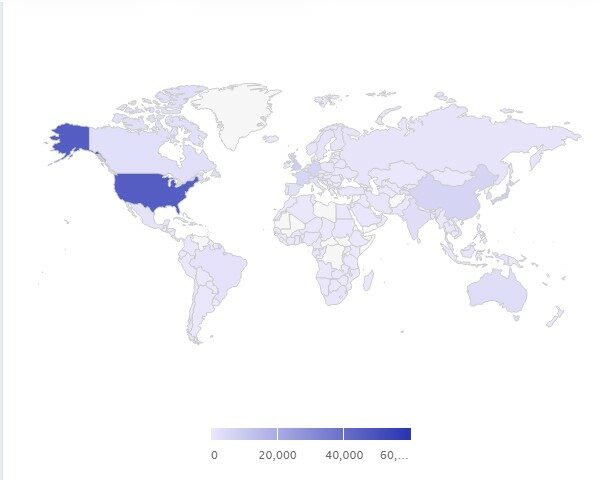
When looking at regional breakdowns, it’s evident that the web hosting industry is most successful in the United States, projected to generate $45,700 million in 2023. North America stands out as the dominant region in the web hosting market, with the highest market share, a concentration of data centers and hosting providers, and leading infrastructure development. India, Netherlands, and Germany also hold prominent positions within this economic sector.
All these regions have proven to be lucrative markets for web hosting services over the past few years and are likely to remain essential components of global profitability going forward, as more companies invest in this technology-oriented area worldwide.
Web hosting Industry
The Web hosting Industry consists of services that provide shared or dedicated hosting of one or more services for their customers. The hosting services industry encompasses data center operations, technological advancements, and the broader hosting ecosystem that supports the global web hosting market.
These services are typically provided by web hosting service providers, which are companies that offer server space, hosting services, and data center facilities to a wide range of customers, including small and medium-sized enterprises (SMEs) seeking an online presence.
A web hosting platform plays a crucial role in delivering scalable and feature-rich hosting solutions to meet the evolving needs of businesses and individuals.
Introduction to Web Hosting
Web hosting is the backbone of the digital world, enabling individuals and organizations to make their websites accessible to internet users across the globe.
At its core, web hosting services involve storing website files, databases, and digital content on specialized servers, ensuring that anyone can access a site at any time.
The web hosting industry has seen remarkable growth, fueled by the surge in demand for online presence and digital services among businesses and consumers alike.
Today’s hosting market offers a wide array of hosting solutions to meet diverse needs.
From shared hosting for small websites to dedicated hosting for enterprise-level applications, and from cloud hosting for scalable performance to virtual private server (VPS) hosting for growing businesses, web hosting companies are constantly innovating to keep pace with evolving requirements.
As the global web hosting market expands, staying informed about the latest web hosting trends and statistics is essential for making strategic decisions about hosting services.
Whether you’re launching a new website or scaling an established online platform, understanding the hosting industry landscape is key to building a strong, reliable digital presence.
Web Hosting Revenue Projection (2023)
The projected revenue of $124.80 billion for the web hosting market in 2023 indicates a strong and sustained demand for web hosting services.
Hosting services market growth is being driven by the increasing number of small and medium-sized enterprises (SMEs), the adoption of multi-cloud hosting solutions, and the rising demand for reliable online infrastructure to support business expansion.
This growth can be attributed to the increasing number of businesses and individuals establishing an online presence, coupled with the growing adoption of cloud computing and data-intensive applications.
The web hosting industry began modestly in 1969 with just four hosts, each connecting to a network using an interconnecting device and a modem. The industry slowly gained traction, but really took off in the 1990s with the dot-com boom of personal homepages and businesses establishing their presence online.
This marked the beginning of two dominant players: shared hosting providers such as WordPress, GoDaddy, and WebHostingDirct; and VPS service providers like Rackspace and Dreamhost.
The shared hosting segment has maintained dominance among SMEs due to its cost-effectiveness and suitability for low traffic websites, while other hosting types like VPS and dedicated hosting are often chosen as companies scale up.
The industry has seen exponential growth since its humble beginnings.
Today, it boasts over 126 million hosts, 30 million domains, and 28.2 million websites demonstrating more than a three-thousandfold increase in hosting services since 1969, with shared hosting services being a key driver of this market expansion.
In terms of economic development, it is now estimated that web hosting generates around $50 billion globally per annum – a testament to the scale and size of this dynamic industry today.
Hosting services market share is largely distributed among major providers like WordPress, with notable regional differences in market share between local and global hosting companies.
Annual Growth Rate of The Web Hosting Market (CAGR 2023-2028)
The projected Compound Annual Growth Rate (CAGR) of 22.55% between 2023 and 2028 showcases the remarkable pace at which the web hosting market is expected to expand.
The forecast period of 2023-2028 is particularly significant, as it highlights the anticipated market growth and scalability of web hosting services during these years.
This growth is likely fueled by ongoing digitalization efforts across industries, including sectors like e-commerce, entertainment, education, and more.
Digital transformation is a key factor impacting business operations and infrastructure, further accelerating the adoption of web hosting solutions. Additionally, digital transformation initiatives are driving the expansion of the web hosting market, especially in regions such as Europe and Asia Pacific.
As more services migrate to online platforms and the demand for reliable hosting solutions rises, the market is poised for substantial growth.
It is incredible to think that in 2023, over 1.21 billion hostnames have been registered online.
This number is huge and shows how important the internet has become in our daily lives across the world. However, while this number seems impressive, it’s important to note that not all of these websites are actively used.
The rapid increase in internet penetration across various regions has played a crucial role in expanding the market for web hosting services, enabling more users and businesses to establish an online presence.
Out of 1.21 billion registered domains, only 200.8 million are actually active on the web today.
In other words, the majority of hostnames with online presence account for merely 15.5% of all domain registrations worldwide – a far cry from what could be perceived at first glance.
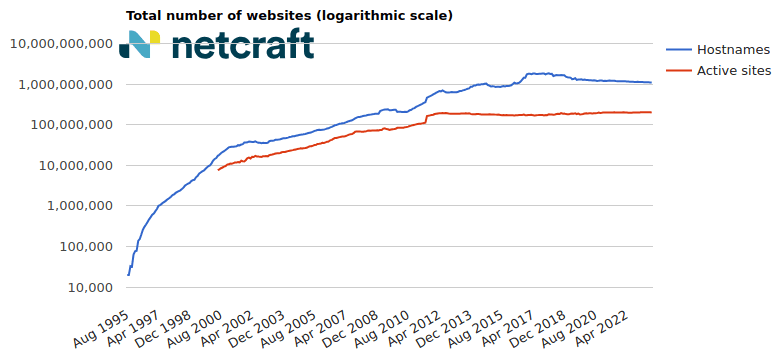
The sheer numbers tell us how many people across the globe rely on the Internet for their day-to-day activities and businesses.
From simple shopping experiences to virtual meetings, so much of our lives is predicated upon having an active website online – or at least being able to access them with relative ease thanks to domain registration services.
We owe a big thank you to those companies providing this essential service offline and remaining committed to its maintenance despite declining website counts overall year after year.
The projection of the web hosting market reaching a volume of US$345.00 billion by 2028 underscores the sustained momentum of growth in the sector.
This substantial market volume implies a growing reliance on web hosting services to support an increasingly interconnected digital ecosystem.
Global Web Hosting Revenue Distribution
The United States is expected to dominate the web hosting market, generating US$45.7 billion in revenue in 2023. This is not surprising given the United States’ role as a global technology hub and its substantial e-commerce sector.
The U.S. market’s leadership in revenue generation emphasizes its technological infrastructure and business landscape conducive to the growth of web hosting services.
Additionally, leading web hosts play a significant role in driving regional market growth and shaping the competitive landscape.
In conclusion, the web hosting market projections by Statista illustrate a thriving industry driven by the increasing demand for online services and the ongoing digitization of various sectors.
The anticipated revenue growth, substantial market volume, and average spend per employee all point toward a sector that is crucial to the digital economy. Website hosting services are essential for supporting enterprise and SME growth, ensuring security, and enabling online commerce.
With a wide variety of web hosting solutions available, businesses can choose options tailored to their specific needs, further fueling the market’s expansion as the United States leads in revenue generation.
Web Hosting Trends
The web hosting industry is rapidly evolving, with new technologies and customer expectations shaping the future of hosting services.
One of the most significant trends is the widespread adoption of cloud hosting, which offers businesses unparalleled scalability, flexibility, and cost efficiency.
Cloud hosting services allow organizations to quickly adjust resources to match demand, making them ideal for dynamic websites and applications.
Another major trend is the rise of managed hosting services. As businesses seek to streamline operations and focus on core activities, managed hosting providers are stepping in to handle server management, security, and maintenance.
This shift enables companies to benefit from expert support and reliable hosting solutions without the need for in-house technical teams.
Security is also at the forefront of web hosting trends. With cyber threats on the rise, web hosting providers are prioritizing secure hosting solutions, offering features like SSL certificates, DDoS protection, and automated backups to safeguard data and ensure business continuity.
As the hosting industry continues to innovate, these trends are shaping the way businesses and individuals choose their web hosting providers, driving demand for advanced, secure, and managed hosting solutions.
Insights on Key Companies and Market Share
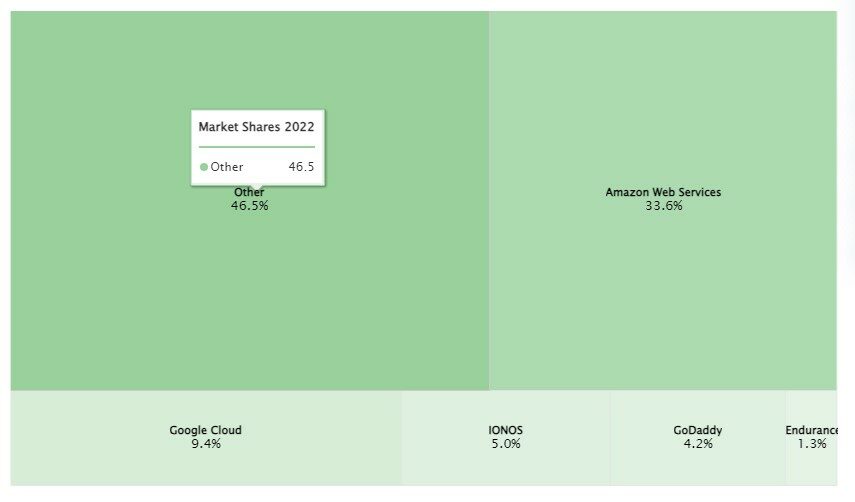
The key players in the web hosting services market offer hosting services to numerous companies for publishing their websites online.
Among them, Amazon Web Services is recognized as a popular web hosting provider with a strong industry presence.
These players aim to increase their market shares by implementing strategies such as investments, launching new products and services, forming partnerships, and engaging in mergers and acquisitions.
Many are expanding their offerings to include professional web services, such as expert website design, marketing, and development, to help businesses grow.
For example, in September 2019, GoDaddy Operating Company, LLC introduced a new website and marketing service that allows companies to create and promote their websites in one place.
The global web hosting services market includes several prominent players and is increasingly focused on serving small and medium enterprises, which are a key driver of demand for hosting solutions due to their growing digital footprint.
- Amazon Web Services
- Endurance International Group
- 1&1 IONOS Inc.
- Liquid Web, LLC
- Google LLC
- GoDaddy Operating Company, LLC
- Hetzner Online GmbH
- Alibaba Cloud
- Equinix, Inc.
- WPEngine, Inc.
Most popular Hosted Website Solutions
Hosted website solutions have become increasingly popular in recent years as more businesses look to the power of the Internet for their business needs.
The website builders market was worth $1.65 billion dollars in 2019, with projections predicting that it will reach a value of $2.16 billion by 2025 due to a CAGR (Compound Annual Growth Rate) of 7%.
In market analysis, the growth of the sector is closely tied to the increasing adoption of web hosting service providers and their evolving offerings.
The top three website builders remain similar from year to year, with Wix dominating at 31.05% market share, followed by Squarespace and Shopify respectively.
These three hosted solutions are considered the most popular because they offer powerful features such as customizable designs, drag-and-drop tools, SEO optimization capabilities, and eCommerce support allowing users to quickly build and launch a website without needing any coding or design experience.
Popularity aside, each of these platforms has different plans and pricing depending on your needs and goals which makes them accessible for businesses of all sizes. For businesses aiming for growth, establishing a strong online presence is essential to remain competitive in the digital economy.
Additionally, the demand for scalable hosting solutions continues to increase, as companies require flexible options that can support their growth and adapt to evolving needs.
Dedicated Hosting
Dedicated hosting stands out as a premium web hosting solution, offering exclusive use of an entire server to a single user or organization.
This approach delivers maximum performance, security, and customization, making it the preferred choice for large businesses, e-commerce websites, and high-traffic online platforms that require robust, reliable hosting services.
With dedicated hosting services, organizations benefit from tailored server configurations, enhanced security protocols, and dedicated technical support.
These features are especially valuable for e-commerce websites handling sensitive customer data or businesses running resource-intensive applications.
While dedicated hosting typically comes at a higher cost and requires technical expertise to manage, its advantages in terms of reliability, speed, and control make it a strategic investment for companies seeking high-performance hosting solutions.
Virtual Private Server Hosting
Virtual private server (VPS) hosting bridges the gap between shared hosting and dedicated hosting, offering a flexible and cost-effective solution for businesses that need more control and resources. By leveraging virtualization technology, VPS hosting divides a physical server into multiple virtual servers, each with its own dedicated resources and operating system.
This setup provides users with greater flexibility, scalability, and security compared to shared hosting, while remaining more affordable than dedicated hosting. VPS hosting is particularly well-suited for small to medium-sized businesses, e-commerce websites, and projects that anticipate growth.
Leading web hosting providers such as Google Cloud Platform and Liquid Web offer VPS hosting plans with features like scalable resources, dedicated IP addresses, and managed support, empowering businesses to optimize website performance and security as they expand.
Managed Hosting Services
Managed hosting services are designed for businesses that want the benefits of professional web hosting without the burden of managing technical details. In a managed hosting environment, the hosting provider takes care of server monitoring, software updates, security patches, and technical support, ensuring that websites remain secure, reliable, and high-performing.
This hosting solution is ideal for organizations that lack in-house IT expertise or prefer to focus on their core business operations. Managed hosting providers, such as GoDaddy Operating Company LLC, offer a range of plans that include dedicated support, regular backups, and proactive security monitoring.
By entrusting hosting management to experienced providers, businesses can reduce operational risks, improve website uptime, and allocate more resources to growth and innovation. Managed hosting services are becoming increasingly popular as companies seek scalable, secure, and hassle-free hosting solutions in a competitive digital landscape.
Market Definition and Scope
The web hosting market refers to the industry segment that provides infrastructure and services to host websites, applications, and other digital content on the Internet.
It involves the storage of website files, databases, and related resources on servers that are accessible to users via the World Wide Web. This industry plays a critical role in enabling individuals, businesses, and organizations to establish an online presence and deliver their content to a global audience.
The scope of the web hosting market encompasses several key hosting solutions, each catering to different needs and preferences. These hosting solutions include:
Cloud hosting has become increasingly popular, offering flexible and scalable solutions for businesses of all sizes. Public cloud hosting services are a popular deployment option, especially for SMEs, due to their low cost, high scalability, and ease of management.
Private cloud environments provide enhanced security, scalability, and dedicated resources, making them ideal for large enterprises. Cloud services, including public, private, and hybrid cloud options, are valued for their flexibility, scalability, and cost-effectiveness, and are being adopted by organizations to meet diverse hosting needs.
Cloud based solutions offer additional advantages such as cost-effectiveness, increased uptime, and flexibility, making them attractive for businesses seeking efficient hosting. Many organizations are also leveraging multiple cloud providers as part of multi-cloud strategies to optimize costs, enhance performance, and avoid vendor lock-in.
Given this scope, the web hosting market caters to a wide range of customers with varying requirements. From individuals looking to establish personal blogs to enterprises needing high-performance solutions for complex applications, the market offers hosting options that align with different budgets, technical needs, and growth plans.
Industry trends such as edge computing are transforming web hosting by enabling low-latency, localized performance and improving real-time application responsiveness, further shaping the future of web infrastructure.
The revenue projections and growth rates provided by Statista encompass these various hosting solutions, reflecting the aggregated demand for shared hosting, dedicated hosting, VPS hosting, and colocation hosting.
As the digital landscape continues to evolve and businesses rely more heavily on online platforms, each of these hosting types contributes to the overall expansion of the web hosting market. The web hosting services industry plays a significant role in the global data center and hosting market, with major players driving innovation and infrastructure growth.
Regionally, the Middle East is experiencing gradual growth in web hosting due to increasing digital adoption and technological advancements, supported by rising data center investments and a shift towards cloud computing to expand digital infrastructure.
In Summary: Web Hosting Industry Market
It is clear that the website hosting industry is currently thriving and showing no signs of slowing down in the near future.
With some projections putting the market value of over $56 billion and a projected CAGR of 15.5%, it is very likely that we will see an increase to $171.4 billion by 2027 if we look at it with this data. Hosting service providers play a crucial role in supporting online presence and digital infrastructure, enabling businesses to scale and maintain reliable operations.
This high growth rate in the industry not only creates more investment opportunities for businesses large and small but also ensures access to support and resources for individuals requiring web hosting services at an affordable rate.
At Web Hosting Resources, we are dedicated to providing reliable and up-to-date information about the industry to make sure you always have access to the latest advancements, advancements that can help your business grow or better support your clients.
We keep track of all market sizes and trends, with the hosting services market size serving as a key metric for industry analysis and investment decisions, so you can make informed decisions on your investments in web hosting resources, platforms, or other web-related technologies.
Frequently Asked Questions (FAQ)
What is the current size of the global web hosting market?
The global web hosting market size is projected to reach approximately $124.80 billion in 2023 and is expected to grow to around $345 billion by 2028, reflecting a compound annual growth rate (CAGR) of 22.55%.
Which regions dominate the web hosting market?
North America, particularly the United States, dominates the web hosting market with the highest revenue generation and market share. Other significant regions include Europe, Asia Pacific, and the Middle East, all experiencing growth driven by digital transformation initiatives and increased internet penetration.
What are the main types of web hosting services available?
The primary types of web hosting services include shared hosting, dedicated hosting, virtual private server (VPS) hosting, cloud hosting (public, private, and hybrid), and managed hosting services. Each caters to different business needs based on traffic, security, scalability, and budget.
Why is dedicated hosting important for businesses?
Dedicated hosting offers exclusive use of an entire server, providing maximum performance, security, and customization. It is ideal for large businesses, e-commerce platforms, and high-traffic websites requiring robust and reliable hosting solutions.
How is cloud hosting influencing the web hosting industry?
Cloud hosting has become a major trend due to its flexibility, scalability, and cost-effectiveness. It allows businesses to quickly adjust resources according to demand, making it suitable for dynamic websites and applications.
What role do small and medium enterprises (SMEs) play in the web hosting market?
SMEs are a key driver of market growth as they increasingly adopt web hosting services to establish and maintain a strong online presence. Shared hosting and public cloud hosting services are particularly popular among SMEs due to their affordability and ease of use.
How is digital transformation impacting the web hosting market?
Digital transformation initiatives across industries are accelerating the demand for reliable, scalable, and secure web hosting solutions. Businesses are migrating more services online, requiring advanced hosting technologies to support growth and innovation.
What are some of the latest web hosting trends?
Key trends include the rise of cloud and hybrid hosting, increased adoption of managed hosting services, enhanced security features, and the growing importance of multi-cloud strategies. Additionally, edge computing and AI-powered hosting solutions are shaping the future of the industry.
How do web hosting providers ensure data security?
Hosting providers implement secure hosting solutions, including SSL certificates, DDoS protection, automated backups, and regular security updates to protect data and maintain business continuity.
What factors should businesses consider when choosing a web hosting provider?
Businesses should evaluate factors such as hosting type, scalability, uptime reliability, security features, technical support, pricing, and the provider’s reputation to select a hosting solution that aligns with their specific needs and growth plans.